

Habitat Tree Works: What Can You Keep in a Sydney Garden?
Updated: Oct 2

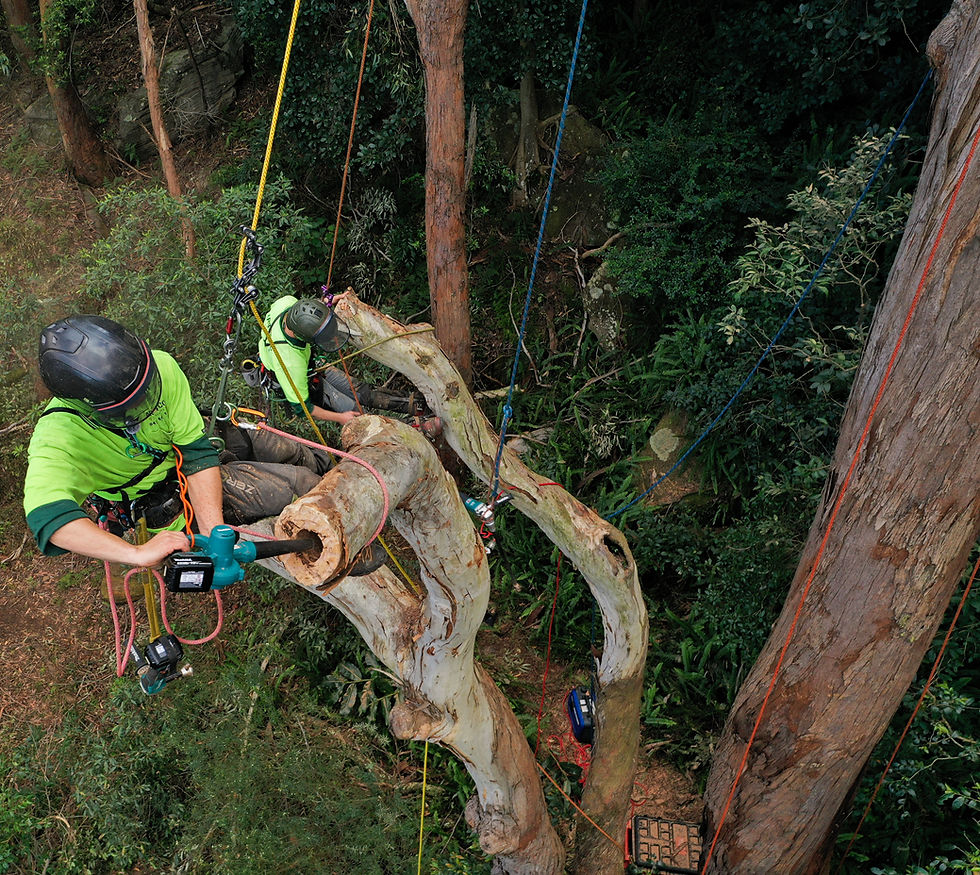
Habitat tree works involve managing trees to retain or create shelter for wildlife while addressing safety concerns. For Sydney homeowners, that may mean keeping a suitable hollow-bearing section, carefully pruning around existing habitat or installing an artificial hollow where conditions allow.
An old tree can look fairly ordinary from the kitchen window. A few bare branches, rough bark, perhaps a dark opening where a limb broke years ago.
Then a bird disappears into that opening.
Suddenly, the question changes. You still need to deal with the branch over the fence, but you’d rather avoid removing something that has become a home.
Across the Northern Beaches and North Shore, where gardens often sit close to bushland, that’s a useful conversation to have before tree work begins.
Why an Old Hollow Matters
A hollow provides something a leafy canopy alone cannot: an enclosed place to shelter, rest or raise young.
Different animals need different spaces. Entrance size, internal depth and position influence which species can use a hollow. The NSW Government’s guide to tree hollows explains how these features provide shelter and protection from weather and predators.
A replacement sapling has value, of course, but it cannot immediately provide the same features as an established hollow-bearing tree.
That’s why the rough-looking parts deserve a closer look before they’re cut away. What appears to be a defect may also be habitat. Sometimes both descriptions are accurate, which is where careful assessment matters.
Can a Damaged Tree Be Partly Retained?
Sometimes, yes. The decision depends on the tree’s condition, the location of its habitat features and what could be affected if a retained section failed.
A tree beside a bedroom or busy footpath presents different considerations from one in a quiet corner of a large garden.
An arborist may find that a particular branch needs removal while a hollow elsewhere can remain. In other cases, reducing a tree to a shorter standing habitat trunk may be worth considering. That requires a suitable structure and location, together with a plan for future inspections.
It isn’t simply a matter of cutting the top off and calling the remainder safe.
Decay continues, conditions change and retained wood still needs management. Where the remaining structure presents an unacceptable risk, keeping it upright may not be appropriate.
What Happens Before Work Starts?
The first step is understanding both the tree and the way the site is used.
Tell the arborist if you’ve noticed birds entering a cavity, possums using the tree or other regular wildlife activity. Even a casual observation can help guide the assessment.
Depending on the job, the planning may consider:
Existing hollows, nests and other potential shelter
Tree structure, decay and damaged branches
Nearby homes, paths, play areas and neighbouring properties
Access for equipment without unnecessary disturbance
Whether an ecologist or wildlife specialist is needed
Applicable council approvals and environmental requirements
An apparently empty hollow should not be assumed to be unused. Some occupants are difficult to see, and activity can vary through the day and year.
Avoid probing a cavity or trying to move wildlife yourself. Where animals are present, the work needs an appropriate plan before cutting begins.
Artificial Hollows Need a Purpose
Artificial hollows and nest boxes can form part of habitat tree works, but their design and placement should suit the wildlife being supported.
A generic box attached wherever the ladder reaches may achieve very little.
The intended species, entrance dimensions, exposure, surrounding vegetation and suitability of the supporting tree all matter. So does the ability to inspect and maintain the installation later.
Carved hollows require particular care because creating a cavity changes the tree itself. A suitably experienced professional needs to assess whether the tree can accommodate that work.
These options can supplement available habitat. They should not be treated as an automatic equivalent to retaining an established natural hollow, and installing one does not guarantee that wildlife will move in.
Sydney Gardens Can Be Awkward Places to Work
There’s often a fence directly underneath the branch you want to retain. Or a pool. Or the neighbour’s shed, which wasn’t there when the tree first grew.
On sloping North Shore blocks, getting equipment into position can influence how sections are removed. Around the Northern Beaches, exposure and proximity to bushland may also shape the assessment.
Then there’s how the garden is actually used.
That quiet corner might be where the grandchildren play on Sundays. The “unused” side passage might be the only way to reach the clothesline. Mention these things. They don’t necessarily appear on a site plan, but they matter when deciding what can reasonably remain.
Does Everything Have to Leave the Property?
Not necessarily.
Where suitable, a removed section may be retained on the ground as a habitat log. That is a separate decision from retaining standing timber and needs thought about placement, access and the surrounding garden.
It won’t suit every block. A narrow courtyard has different practical limits from a garden adjoining a bushland reserve. Bushfire management requirements may also affect what material can remain and where.
If you’re interested, raise it before the quote is finalised. Once everything has been chipped and loaded, the opportunity has passed.
Plan for What Happens Afterwards
Retained habitat needs follow-up.
Ask what should be inspected, who should inspect it and what changes should prompt another assessment. A retained trunk, artificial hollow or nest box should have a maintenance approach suited to its condition and location.
You can observe wildlife from a distance without opening boxes or disturbing cavities. If you notice fresh damage or a change in the retained structure, arrange advice rather than attempting repairs yourself.
Arbor Co’s habitat creation and ecological restoration services in Sydney support projects that combine tree management with wildlife habitat.
When enquiring, explain the tree problem as well as what you’d like to preserve. Photographs and observations are a useful starting point, followed by a site assessment.
Sometimes there is more worth keeping than you first thought.


Comments